Table of Contents
Gemini Omni Video API for Modern Development
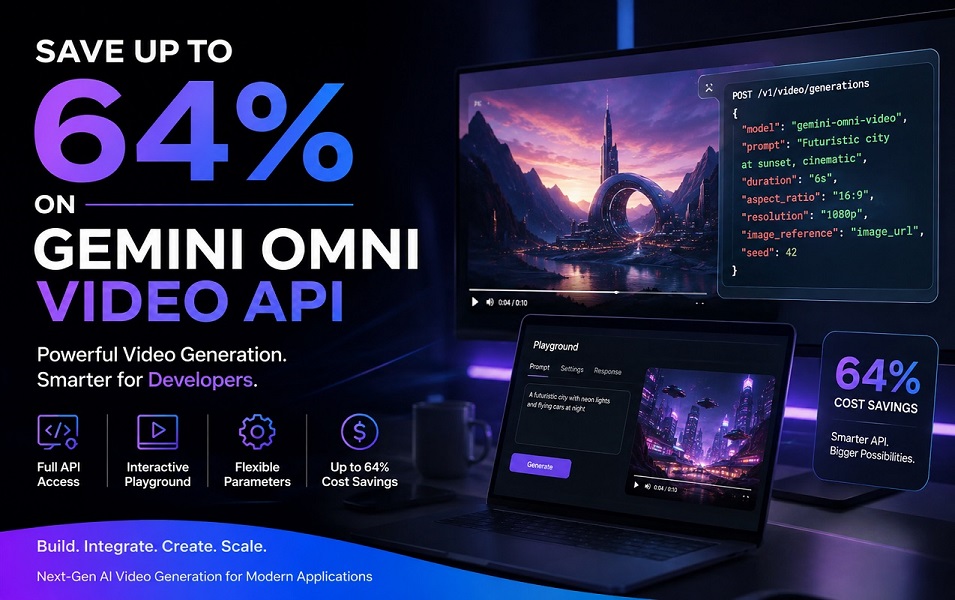
AI video generation is becoming an important capability for applications, creative platforms, marketing tools, and automated content workflows. Developers can save up to 64% on Gemini Omni Video API when using the API access and pricing options available through you.bot, making advanced video generation more practical for projects with demanding usage requirements. Instead of treating video generation as an isolated creative feature, developers can integrate it directly into software products, internal tools, automation systems, and customer-facing applications.
The Gemini Omni Video model supports programmatic video generation through an API-oriented workflow, allowing developers to send structured requests rather than relying exclusively on a graphical interface. This approach is particularly useful for applications that need repeatable generation, automated prompts, reference media, selected durations, aspect ratios, and different output resolutions. By connecting video generation to existing application architecture, development teams can create workflows where AI-generated video becomes a functional part of the product rather than a separate manual process.
Full API Access for Developer Workflows
Developers often need more than a simple interface for experimenting with an AI model. Full API access makes it possible to connect Gemini Omni Video with backend services, content management systems, marketing platforms, creative applications, and automated pipelines. A developer can construct requests, send generation jobs, receive task information, and build application logic around the resulting workflow.
The API approach also makes scaling easier because generation can become part of established software architecture. Teams can create custom interfaces for their users while keeping the underlying generation process controlled by backend services. This flexibility can support applications such as automated advertising platforms, social media content tools, video prototyping systems, educational software, product demonstration generators, and creative production environments where users need video generation without leaving the application.
Interactive Playground for Faster Testing
An interactive playground can significantly reduce the time developers spend moving between documentation and code while learning an API. It gives developers a practical environment for testing prompts and input combinations before implementing them in a production application. This is especially valuable when working with video because small changes to prompts, duration, resolution, or reference inputs can influence the generated result.
The playground can also help developers understand how the model behaves before they commit engineering resources to a larger integration. Developers can experiment with supported options, inspect the expected inputs, and refine their generation strategy through repeated tests. Once an effective configuration is identified, the same concepts can be transferred into application code, helping reduce development friction and making the transition from experimentation to integration more straightforward.
Flexible Video Generation Parameters
A useful video API should provide developers with meaningful control over generation instead of reducing every request to a single text prompt. Gemini Omni Video supports parameters that can influence duration, aspect ratio, and output resolution, giving developers greater control over how generated content fits into their applications. Different products can therefore design generation workflows around their specific publishing or presentation requirements.
For example, a social media application may favor vertical video, while a website builder may require a landscape format. A creative prototype could prioritize shorter generations for rapid iteration, whereas a production workflow might require longer clips. Developers can also work with resolutions such as 720p, 1080p, and 4K where supported, allowing applications to balance visual quality, processing requirements, and project budgets according to the intended use case.
Reference Images and Creative Inputs
Text-to-video generation becomes more useful when applications can incorporate visual references. Gemini Omni Video supports image inputs, enabling developers to build workflows where generated content is influenced by supplied imagery. This can be valuable for product visualization, character concepts, campaign development, storyboarding, and other applications where maintaining a connection to existing visual material is important.
Developers can design interfaces that allow users to provide reference images and combine them with descriptive prompts. Instead of manually recreating every visual instruction through text, users can supply relevant assets as part of the generation process. This creates opportunities for more sophisticated creative applications, including tools that transform product concepts into promotional clips, turn visual ideas into animated scenes, or help creative teams explore multiple directions from a shared starting point.
Cost Efficiency for High-Volume Projects
Video generation can become expensive when an application produces hundreds or thousands of clips, particularly when developers need multiple iterations during testing. Cost efficiency therefore becomes an important consideration when selecting an API infrastructure. With available pricing options, developers can save up to 64% on Gemini Omni Video API for eligible generation configurations and top-up pricing, potentially making high-volume experimentation and production workloads more economical.
The practical benefit of lower generation costs becomes more apparent as usage grows. A small prototype may only require a few generations each day, while a commercial application could generate content continuously for many users. Reducing the cost of individual generations can help developers allocate more of their budgets toward infrastructure, user acquisition, product development, storage, and other operational requirements without necessarily reducing the number of creative experiments performed.
Building Applications around Asynchronous Generation
Video generation is naturally suited to asynchronous application design because generation may take longer than ordinary API operations. Developers can create workflows in which an application submits a generation request, receives a task identifier, and checks the task status before presenting the completed result. This model allows the frontend to remain responsive while the backend manages the generation lifecycle.
An asynchronous design can also support queues, notifications, retry logic, usage tracking, and job management. Developers can place generation requests into a controlled workflow rather than forcing users to wait on a single synchronous operation. For larger platforms, this architecture can be extended with background workers and database records that track generation status. Such an approach helps make AI video functionality more reliable and easier to manage as application demand increases.
Practical Integration for Production Applications
Moving from an experiment to production requires developers to think beyond simply sending prompts. Production integrations need secure API key handling, input validation, error management, usage monitoring, request tracking, and appropriate frontend feedback. A well-designed implementation can hide technical complexity from end users while providing them with a simple interface for generating videos.
Developers can also create application-specific prompt templates that standardize generation requests. For example, a marketing platform could collect information about a product, audience, visual style, and campaign objective before automatically constructing a structured prompt. A video creation service could provide predefined generation modes for advertisements, social clips, product explainers, or promotional scenes. These approaches turn a general-purpose model into a specialized feature tailored to a particular business use case.
Scaling Creative Automation with API Integration
API-based video generation becomes particularly powerful when connected with automation. Developers can build systems that automatically generate video assets from product catalogs, campaign databases, publishing schedules, or user submissions. This can reduce repetitive manual work and allow teams to produce larger volumes of visual content without requiring every individual generation to be handled manually.
Automation can also connect video generation with other software services. A workflow might collect structured information from a database, generate a prompt, submit the request, monitor its status, and then store or publish the resulting video. Such integrations can support personalized marketing, content localization, educational materials, product presentations, and internal communications. The API therefore becomes a building block within a broader software workflow rather than simply a standalone generation endpoint.
Getting More Value from Gemini Omni Video
For developers evaluating an AI video service, the combination of API access, an interactive playground, flexible generation controls, and competitive pricing can make experimentation considerably easier. The ability to test ideas interactively before implementing them in code can reduce unnecessary development cycles, while API integration provides the foundation for turning successful experiments into reusable product features.
The strongest use cases are likely to come from developers who approach video generation as an application capability rather than an isolated novelty. Teams can start with small experiments, measure output quality and costs, establish reliable prompt patterns, and then expand into automated workflows. With an efficient integration strategy and careful control of generation parameters, Gemini Omni Video can become a practical component for applications that need scalable AI-generated visual content.
Developer-Friendly Path from Testing to Deployment
A successful AI video integration usually begins with experimentation and gradually moves toward production. Developers can use the playground to understand model behavior, evaluate prompts and parameters, and determine which generation settings fit their application. Once those requirements are clear, the API provides a path toward integrating the capability into custom software and automated workflows.
For teams working with substantial generation volumes, pricing efficiency can be just as important as technical functionality. The opportunity to save up to 64% on Gemini Omni Video API can make it easier to test more creative variations, support larger user workloads, and maintain predictable development economics. By combining interactive experimentation with programmatic access, developers can move from an initial concept to a scalable video-generation feature while maintaining greater control over the overall application experience.