ai advertising agency
Table of Contents
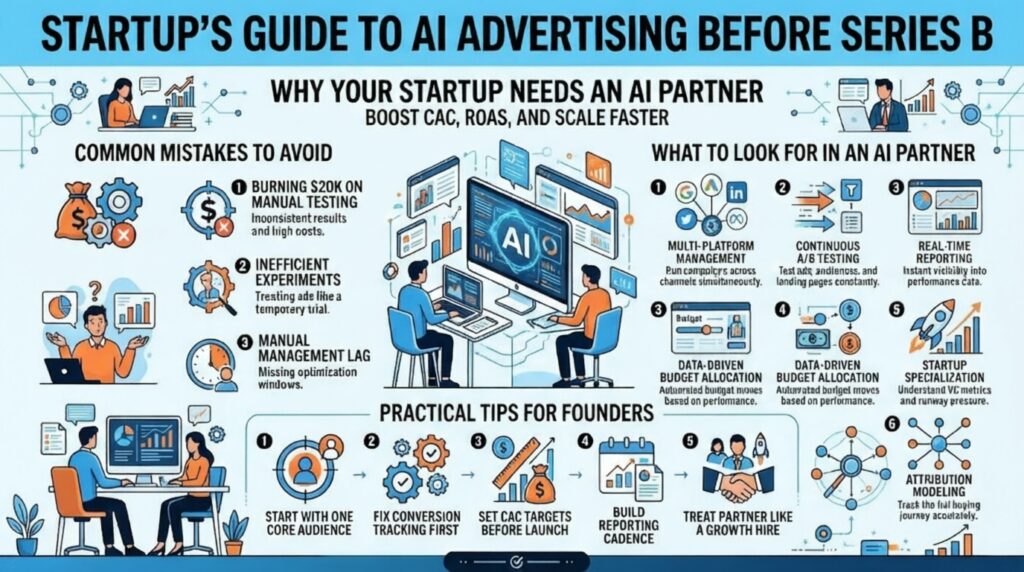
Most seed-stage founders discover their ad problem too late. They burn $20K testing channels manually, get inconsistent results, and then walk into a Series B pitch with weak CAC numbers. Investors notice. They always notice. An ai advertising agency partner can change that trajectory before it costs you the round.
What Most Startups Get Wrong About Ads Before Series B
Early-stage founders treat advertising like an experiment. They run a few campaigns, check results weekly, and rotate creatives when they remember. This approach made sense when ad platforms were simpler. It does not work anymore.
Modern ad platforms use machine learning to optimize delivery. To feed that machine, you need volume, consistency, and speed. Manual management cannot keep up. By the time a human reviews performance data and makes changes, the window for optimization has already closed.
The startups that reach Series B with strong unit economics are not the ones who spent less. They are the ones who spent smarter, faster, and across the right channels simultaneously.
Series B investors look at one thing above everything else: can this company scale efficiently? Your ad data is proof. CAC trends, ROAS by channel, conversion rates across the funnel — these numbers tell the story of your growth engine. If your numbers are inconsistent or unexplainable, that is a red flag.
What to Look For in an AI Advertising Partner
Multi-Platform Management
Your customers do not live on one platform. They see ads on Google while researching, on LinkedIn while networking, and on Meta while scrolling. An effective partner runs campaigns across all three simultaneously and allocates budget based on real-time performance data — not last month’s report.
Continuous A/B Testing
Single-variable testing on a monthly cycle is too slow. Look for a partner that tests ads, audiences, and landing pages on a rolling basis. Small improvements compound. A 5% better CTR across three platforms adds up fast.
Real-Time Reporting
You should not wait for a weekly PDF to know if your campaigns are working. Real-time dashboards give you the data to make faster decisions. When something breaks, you find out in hours, not days.
Data-Driven Budget Allocation
Moving budget between channels based on performance is one of the highest-leverage actions in paid advertising. It requires real-time data and automated rules. Manual budget management introduces lag that costs money.
Startup Specialization
A general agency built for enterprise clients will not understand your constraints. You need a partner who knows VC metrics, understands runway pressure, and can translate ad performance into language that works in an investor deck. CAC, LTV, and payback period should be part of every reporting conversation.
Attribution Modeling
Last-click attribution lies. It ignores every touchpoint before the final conversion and makes some channels look useless. Proper attribution modeling shows you how each platform contributes to the full buying journey. Without it, you make budget decisions based on bad data. A strong ai advertising agency makes this the default, not the exception.
Practical Tips for Founders Running Ads Before Series B
Start with one core audience. Define the ICP tightly. Run ads to that one audience across platforms before trying to expand. Spreading thin early produces data that is too noisy to act on.
Fix your conversion tracking first. Before spending a dollar on ads, make sure every conversion event fires correctly. Bad tracking produces bad data. Bad data produces bad decisions.
Set CAC targets before you launch. Know what CAC is acceptable at your current LTV. Use that number as the guardrail for every campaign. If you cannot define an acceptable CAC, you are not ready to scale.
Build a reporting cadence for investors. Monthly ad performance summaries show traction and discipline. They also force you to explain your numbers, which sharpens your strategy.
Treat your ad partner like a growth hire. A good ai advertising agency is not a vendor. They should sit inside your growth strategy, attend planning sessions, and understand what you are trying to prove before the next raise.
The Competitive Pressure You Cannot Ignore
Your Series B competitors are not running manual campaigns. They are using AI-assisted platforms, automated creative testing, and real-time budget optimization. If you are not doing the same, you are paying more for the same results — or worse, paying the same for fewer results.
Getting your advertising right before Series B is not optional. It is part of the proof you need to raise.
The window between Seed and Series B is tight. Use it to build a repeatable, measurable growth engine. The founders who do are the ones who walk into the next round with data that speaks for itself.